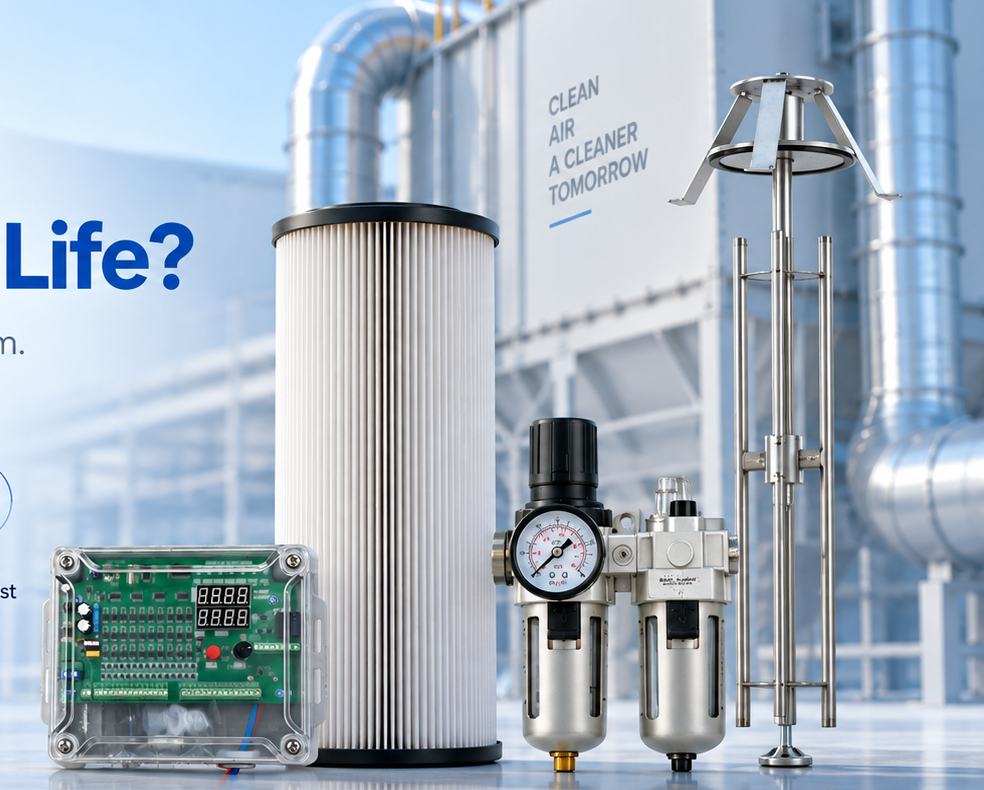

In industrial dust collection systems, cartridge filters are consumable components that require regular replacement.
Extending cartridge filter life not only reduces filter replacement costs, but more importantly, helps minimize production downtime and maintenance workload.
To achieve more stable operation and longer filter life, two aspects are particularly important:
Choosing the right cartridge filter + providing the right cleaning conditions
Choose the Right Cartridge Filter
1. Proper Air-to-Cloth Ratio
Excessive filtration velocity is one of the primary causes of premature cartridge filter failure.
When filtration velocity is too high, dust is forced deeper into the filter media. Once embedded, the dust becomes difficult to remove during cleaning, causing the differential pressure to keep rising rather than returning to a normal level.
Therefore, selecting an appropriate air-to-cloth ratio is essential for maintaining stable filtration performance and extending filter life.
2. Select the Filter Media According to Dust Characteristics
Different types of dust have different requirements for filter media.
Powder coating dust, wood dust, cement dust, metal dust, etc. can differ significantly in terms of particle size, humidity, adhesion, and abrasiveness.
In addition to the basic requirements of high filtration efficiency and low pressure drop, it is also important to consider whether PTFE membrane treatment is appropriate for the application.
At the same time, avoid simply pursuing a larger filtration area per cartridge. Overly dense pleating can increase the difficulty of dust release during cleaning, reducing the actual cleaning effectiveness.
Provide the Right Cleaning System
Even a high-quality cartridge filter needs a properly matched cleaning system to achieve its full potential.
1. Pre-Separation
Proper pre-separation before dust reaches the cartridge filters can reduce the dust load on the filters.
For example, cyclone separators, baffles, or other pre-separation structures can remove larger and heavier particles before they reach the cartridge filters.
Reducing the dust load carried by the cartridge filters is one of the most cost-effective improvements you can make.
2. Differential Pressure Control
Differential-pressure-controlled pulse cleaning is one of the most fundamental and effective intelligent functions in a dust collection system.
Clean on demand, rather than simply cleaning at fixed time intervals.
This helps avoid:
Insufficient cleaning → Continuously rising differential pressure
while also reducing:
Excessive cleaning → Unnecessary mechanical stress on the filter media
The cleaning process can therefore respond to the actual operating condition of the cartridge filters.

3. Rotary Wing Cleaning
Upgrading the cleaning components can directly improve cartridge filter cleaning performance.
Compared with traditional single-point pulse-jet cleaning, rotary wing cleaning can provide 360° uniform cleaning coverage, helping to avoid a common problem with conventional pulse cleaning: areas close to the air outlet may be repeatedly impacted, while areas farther away may not be cleaned sufficiently.
At the same time, the cleaning effect is more predictable and differential pressure can remain more stable.
Combined with a differential pressure controller, rotary wing cleaning can further improve the overall cleaning performance.

4. Improve Compressed Air Quality
If compressed air containing water and oil enters the pulse cleaning system, it can cause a dense, difficult-to-remove dust cake to form on the filter media.
A refrigerated air dryer, oil-water separator, and regular condensate drainage are therefore important for maintaining proper cleaning performance.
The total cost of these measures is often far lower than the cost of replacing all the cartridge filters in the system.
Finally: Cartridge Filter Life Is a System Issue
Extending cartridge filter life is not simply about buying a more expensive filter.
What really matters is making all the components work together as one integrated system.
A good cartridge filter provides effective filtration. A properly designed cleaning system helps maintain that filtration performance over time.
When these two aspects are properly matched, the dust collection system can achieve more stable operation and a longer cartridge filter service life.

How long do your cartridge filters normally last?
Is the main challenge filter selection or cleaning performance in your application?
Feel free to share your real-world operating conditions in the comments section.