
How to Enhance the Intelligence of Dust Collectors: 6 Smart Pulse Controller Functions
In industrial dust collection systems, effective filter cleaning depends on more than pulse valves and compressed air. The control system also plays a key role.
A smart pulse controller helps coordinate cleaning cycles, monitor differential pressure, and integrate other equipment. With the right configuration, it can improve cleaning management and support more stable system operation.
Here are six key functions to consider when selecting a smart pulse controller.
1. Differential Pressure Cleaning
Instead of cleaning only at fixed time intervals, differential pressure cleaning triggers the cleaning cycle according to preset pressure conditions.
When the differential pressure reaches the set threshold, the controller can activate pulse cleaning. The cleaning process can stop or pause according to the configured control logic.
Key benefits:
- Enables cleaning based on actual operating conditions.
- Helps manage filter pressure drop.
- Reduces unnecessary cleaning cycles when properly configured.
This function is particularly useful for cartridge dust collectors, baghouse systems, and powder recovery equipment with changing dust loads.
2. Fan Interlocking and Offline Cleaning
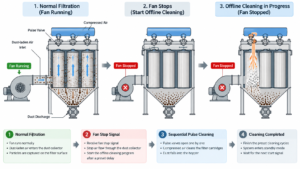
A smart pulse controller can work with fan status signals to coordinate cleaning with equipment operation, provided the model supports this function.
For systems designed for offline cleaning, the controller can continue a preset cleaning sequence after the fan stops.
Key benefits:
- Coordinates fan operation and filter cleaning.
- Supports automatic cleaning after shutdown.
- Reduces the need for manual operation.
The cleaning sequence and delay settings should match the dust collector design and operating requirements.
3. Combined Cleaning Modes
Different operating conditions may require different cleaning strategies. Some controllers support combined modes, such as timed cleaning and differential pressure-based control.
This allows the cleaning strategy to be adjusted according to system requirements rather than relying on a single fixed setting.
Key benefits:
- Greater flexibility in cleaning control.
- Better adaptability to changing dust loads.
- Easier adjustment of cleaning parameters.
Available modes depend on the controller model and its configuration.
4. Smart Monitoring
Monitoring system conditions helps operators identify changes before they develop into larger maintenance problems.
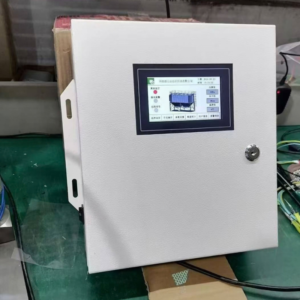
Depending on the model, a smart pulse controller may display differential pressure, cleaning status, alarms, and other operating information. Touchscreen models can also make parameter setting and status checks more convenient.
Key benefits:
- Clearer visibility of operating conditions.
- Easier troubleshooting and maintenance.
- More convenient access to control settings.
The available monitoring functions depend on the controller’s sensors, interface, and software configuration.
5. Centralized Control of Valves and Actuators
Industrial dust collection systems may require more than pulse valve control. Other components, such as pneumatic hammers and cylinders, may also need to operate as part of the overall process.
Controllers with suitable outputs and control logic can coordinate pulse solenoid valves and additional actuators according to preset sequences.
Key benefits:
- Centralized management of cleaning operations.
- Coordinated control of pneumatic hammers and cylinders.
- Greater flexibility for system integration.
Before selecting a controller, confirm the required output channels, electrical specifications, and compatibility with the connected equipment.
6. RS485 Communication
For automated factories, connecting dust collection equipment to a PLC or supervisory monitoring system can simplify equipment management.
A pulse controller with RS485 communication can exchange data with compatible systems when the communication protocol and configuration are supported.
Key benefits:
- Supports integration with industrial automation systems.
- Enables centralized monitoring of compatible devices.
- Provides a communication option for future system upgrades.
RS485 is a communication interface. Supported data, protocols, and remote functions must be confirmed for the specific controller model.
How to Choose the Right Smart Pulse Controller
Before selecting a controller, consider these five factors:
- Cleaning method: Timed cleaning, differential pressure cleaning, or combined modes.
- Fan interlocking: Whether offline cleaning and fan status inputs are required.
- Output requirements: The number of pulse valves and additional actuators to control.
- Monitoring and communication: Touchscreen operation, alarms, operating data, and RS485.
- System compatibility: Power supply, sensor inputs, output specifications, and installation conditions.
Conclusion: Smarter Control for More Effective Filter Cleaning
A smart pulse controller does more than activate pulse solenoid valves. With the right configuration, it can support differential pressure cleaning, offline cleaning, combined control modes, system monitoring, actuator coordination, and RS485 communication.
When properly matched with pulse valves, filters, compressed air systems, and other components, it helps create a more coordinated and manageable dust cleaning system.
SYMFILTER provides pulse control solutions for industrial dust collectors and powder recovery systems. Contact us to discuss a controller configuration suited to your equipment and cleaning requirements.